Control of mitochondrial network size

A fundamental question in cell biology remains how organelle size scales with cell size to ensure proper cellular physiology and organelle inheritance upon division. In particular, how is mitochondrial to cell size scaling achieved in asymmetrically growing cells such as budding yeast? Is the same mitochondrial to cell volume ratio (Vmito/Vcell) maintained throughout the cell to produce identical mother and daughter cells? Or is there an asymmetry in the inheritance of mitochondrial content? And if so, how would a population-wide scaling relation exist despite this asymmetry?
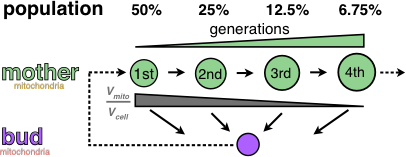
Applying the Mitograph approach, we found that mitochondrial network size increases with increasing cell size and that this scaling is primarily achieved in the bud compartment at the expense of maintaining the mitochondrial volume ratio in the mother. Regardless of the size, mitochondrial content, or age of the mother, all buds attain the same average mitochondrial volume ratio. Aging mothers experience a continued decrease in their mitochondrial volume ratio over successive generations.
The daughter buds become newborn mothers, which comprise half of the population at any time, while mothers of increasing generational age comprise a decreasing proportion of the population. Together, this asymmetry in mother-bud mitochondrial behavior achieves the observed population-wide, stable, mitochondrial to cell size scaling relation.
We are now following up on how the proper mitochondrial volume ratio is achieved in the bud at time of division. We are combining a candidate gene approach with building a predictive mathematical model of mitochondrial accumulation in mothers and buds based on our quantitative experimental data.