Control of mitochondrial network topology

Are the topological properties of mitochondrial networks specifically regulated by the cell (and how)? Or are they simply the result of random connections?
We are performing a comprehensive quantitative analysis of topology as a function of the spatial density of tubules at the cell periphery, the physical size of the network, and the rate and distribution of fusion and fission events within the network in wild-type cells. These results will provide a quantitative framework for comparison to simulated networks, which we are generating with an in silico geometric model of connected nodes on the surface of an ellipsoid.
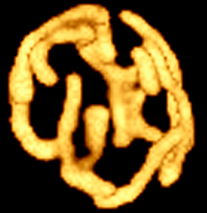
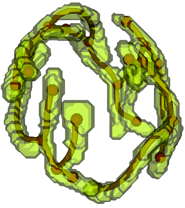
Our initial model consists of randomly connected simulated networks. We will step-wise incorporate experimentally determined constraints on topology as well as fusion and fission events to investigate the basic requirements for generating quantitatively realistic mitochondrial networks. We will also perturb the relative and absolute fusion and fission rate experimentally and iterate between model predictions, new experiments, and model refinement to achieve a detailed understanding of the basic underlying principles that control network topology.
3D volume
3D skeleton
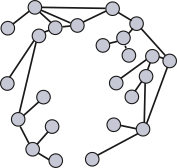
2D depiction
of the mito-graph
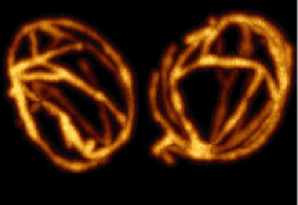
simulated networks